Jaffna
Sri Lanka's Tamil cultural capital in the far north — Nallur Kovil, the Dutch fort, offshore islands, and a cuisine unlike anywhere else on the island.
- Altitude
- 5 m
- Coordinates
- 9.662°, 80.025°

Current Weather
Jaffna is far enough from the rest of Sri Lanka — nine hours by road from Colombo, at the top of a flat limestone peninsula — that it reads as a different country. The language on the shopfronts is Tamil, the temples are Hindu rather than Buddhist, the food is hotter and more heavily built on palmyra and seafood, and the light on the peninsula is harder and whiter than anywhere in the hill country. It is the most rewarding place in Sri Lanka to travel if you want the island to stop looking like a single culture.
Nallur
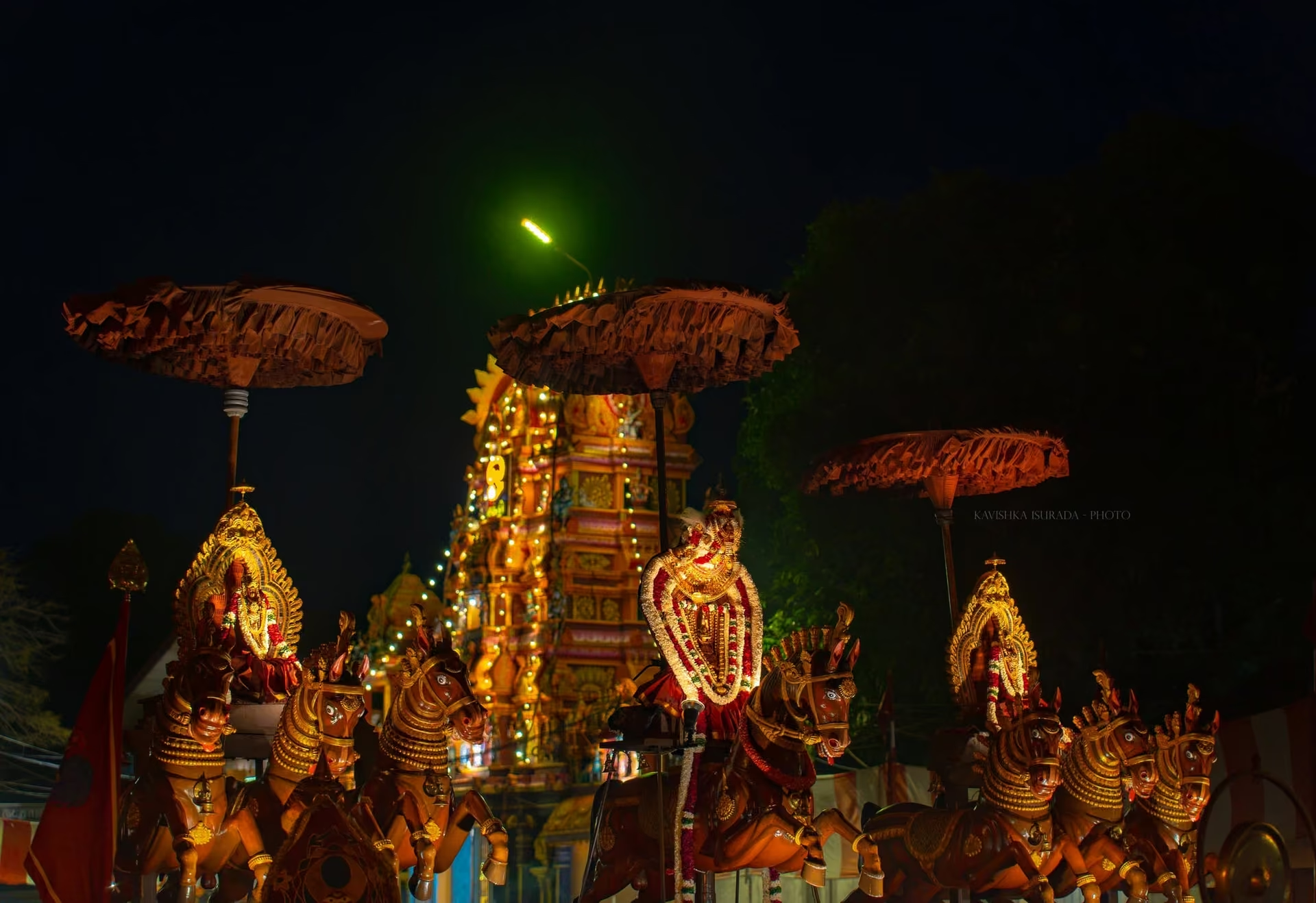
The Nallur Kandaswamy Kovil, dedicated to Murugan, is the peninsula's great temple and the centre of its religious life. The present structure dates from the eighteenth century, rebuilt after the Portuguese destroyed the earlier temple, but Nallur as a site goes back to the capital of the medieval Jaffna Kingdom. Its gold-tiered gopuram is visible across the low town.
The Nallur Festival in July–August runs for twenty-five days and is the biggest event in the north: nightly processions, a chariot day, and kavadi bearers under vows. Men remove shirts before entering the temple; everyone removes shoes. Photography rules vary by day and are worth asking about rather than assuming.
Fort, library, and the memory of the war
Jaffna Fort was begun by the Portuguese in 1618 and vastly expanded by the Dutch after 1658 into one of the largest star forts in Asia. It was fought over repeatedly during the civil war and much of the interior is ruin; the ramparts have been restored and the walk around them at sunset, over the lagoon, is the best free thing to do in the city.
The Jaffna Public Library is a white 1930s building of real symbolic weight. It held one of Asia's finest Tamil collections until it was burned in 1981, an event that sits close to the origin of the war. It was rebuilt and reopened in 2004. Visitors are welcome; it is a working library, not a monument, and should be treated that way.
Reminders of the conflict are ordinary here rather than curated — shelled buildings, memorials, resettled land. Ask questions if you are invited to, but the north is not a war-tourism circuit, and people's willingness to discuss it varies enormously.
The islands and the coast
A causeway runs west from the city out to Kayts and Karainagar, where Casuarina Beach is the peninsula's calm, shallow swimming beach. Ferries run out to Nainativu, which holds both the Hindu Nagapooshani Amman Kovil and the Buddhist Nagadeepa Vihara — one of the sixteen places tradition says the Buddha visited, and a genuinely shared pilgrimage island. Delft, an hour further out by boat, has wild ponies, coral-block walls, and a Dutch-era fort ruin.
North of the city, Point Pedro is the island's northernmost town, and the road there runs past palmyra stands and toddy tappers the whole way.
Eating
Jaffna food is the reason many people come back. Jaffna crab curry, dark with roasted spice and pepper; odiyal kool, a thick seafood soup thickened with palmyra-root flour; sea-urchin and cuttlefish dishes on the coast; and pittu and string hoppers for breakfast rather than the hoppers you get in the south. Palmyra shows up everywhere — as flour, as jaggery, as toddy.
Getting here
The Yal Devi train from Colombo Fort takes six to seven hours to Jaffna and is the easy way in; night trains and express buses also run. Jaffna International Airport at Palaly has limited domestic and regional flights. Within the peninsula, distances are short but public transport is thin — a hired car, scooter, or tuk-tuk for the day is the practical option.
Location
Related
Connected places and entries worth pairing