Temple · Buddhist
Temple of the Sacred Tooth Relic
Sacred Tooth Relic of the Buddha·16th-19th century·Central Province·UNESCO World Heritage
Sri Lanka's most revered Buddhist shrine, enshrining the Buddha's tooth relic within the old royal complex in Kandy.

Dedicated to
Sacred Tooth Relic of the Buddha
Period
16th-19th century
Hours
Daily temple sessions around morning, midday, and evening puja hours.
Neighborhood
Kandy Lake
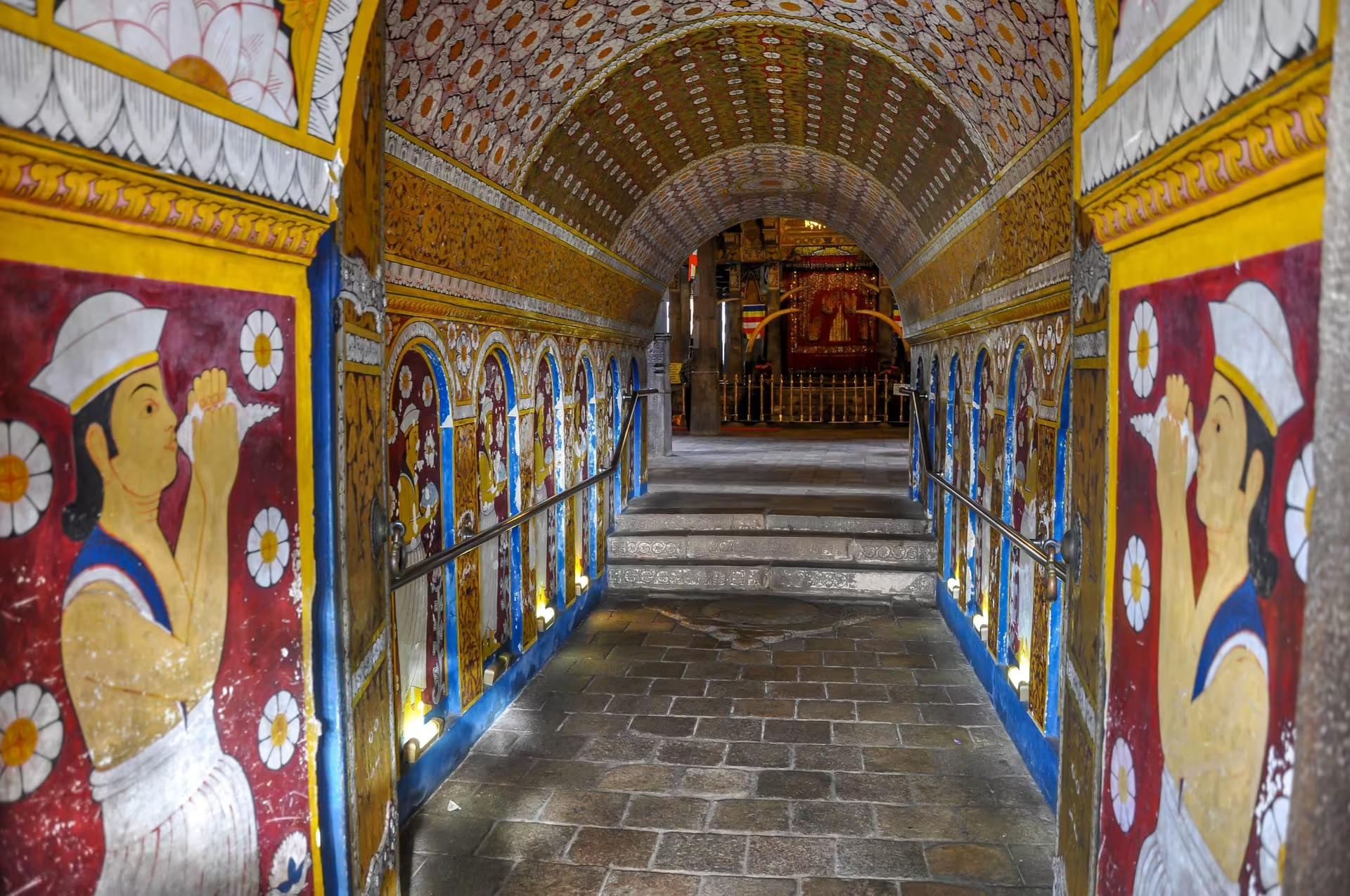
The Temple of the Sacred Tooth Relic — Sri Dalada Maligawa — is the spiritual center of gravity of Sri Lanka. Inside its gilded shrine room, within seven nested golden caskets, rests what Buddhists revere as a tooth of the Buddha himself. For sixteen centuries, the relic has been more than an object of devotion: it has been the title deed to the island.
The relic that crowned kings
Tradition holds that the tooth was carried to Sri Lanka from Kalinga in eastern India in the 4th century CE — hidden, the story goes, in the hair of a princess — and received by King Kirti Sri Megavanna of Anuradhapura. From the beginning it was treated as a palladium of sovereignty: whoever held the relic held the right to rule. So the tooth moved with power itself — from Anuradhapura to Polonnaruwa and onward through each successive capital, until it came to rest in Kandy, the last kingdom, where the kings built their palace around it. The present temple complex, with its moat, octagonal Paththirippuwa tower, and golden canopy, took shape under the Kandyan kings of the 17th and 18th centuries.
A living shrine
This is no museum. Three times a day — at dawn, midday, and evening — the temple performs the tevava rituals: drummers in the hewisi hall, conch blasts, oil lamps, and long queues of white-clad pilgrims carrying lotus and jasmine up to the shrine room, where the casket is displayed behind a golden screen. The air is thick with incense and frangipani. Come at puja time or not at all — the rituals are the temple.
Destruction and defiance
In January 1998, an LTTE truck bomb detonated at the temple entrance, killing worshippers and shattering the Paththirippuwa, the great gateway, and the carved moonstone at the threshold. The restoration — completed within about a year and a half — was carried out with traditional materials and craftsmen, and was read across the island as an act of national defiance: the relic itself was untouched, and the rituals never stopped.
Esala Perahera
Each July–August the temple stages the Kandy Esala Perahera, when a replica casket of the relic is carried through the city on a ceremonial tusker amid ten nights of drummers, dancers, and fire — the island's grandest festival and one of the oldest continuously performed processions in the Buddhist world.
Visiting
Dress to cover shoulders and knees, remove shoes and hats, and allow time for security queues — this is both a sacred site and a guarded one. The evening puja (around 6:30 pm) has the strongest atmosphere; mornings are quieter. The temple sits beside Kandy Lake, and the royal palace buildings around it house museums worth an extra hour. Plan timing with the festival timing guide if you want to pair a visit with the Perahera.
Folio II
Iconography & Detail
Coda
Continue the Pilgrimage
Related
Connected places and entries worth pairing
